The Hidden Cost of Undocumented Processes in Banking

In the high-stakes, highly regulated world of financial services, undocumented processes are a silent killer. They are the invisible debt that accumulates on your balance sheet, not in financial terms, but in operational risk. Critical operational knowledge often lives exclusively in the heads of long-serving employees—a phenomenon known as "tribal knowledge." While this expertise is valuable, relying on it without documentation creates significant operational risk, scalability bottlenecks, and regulatory exposure.
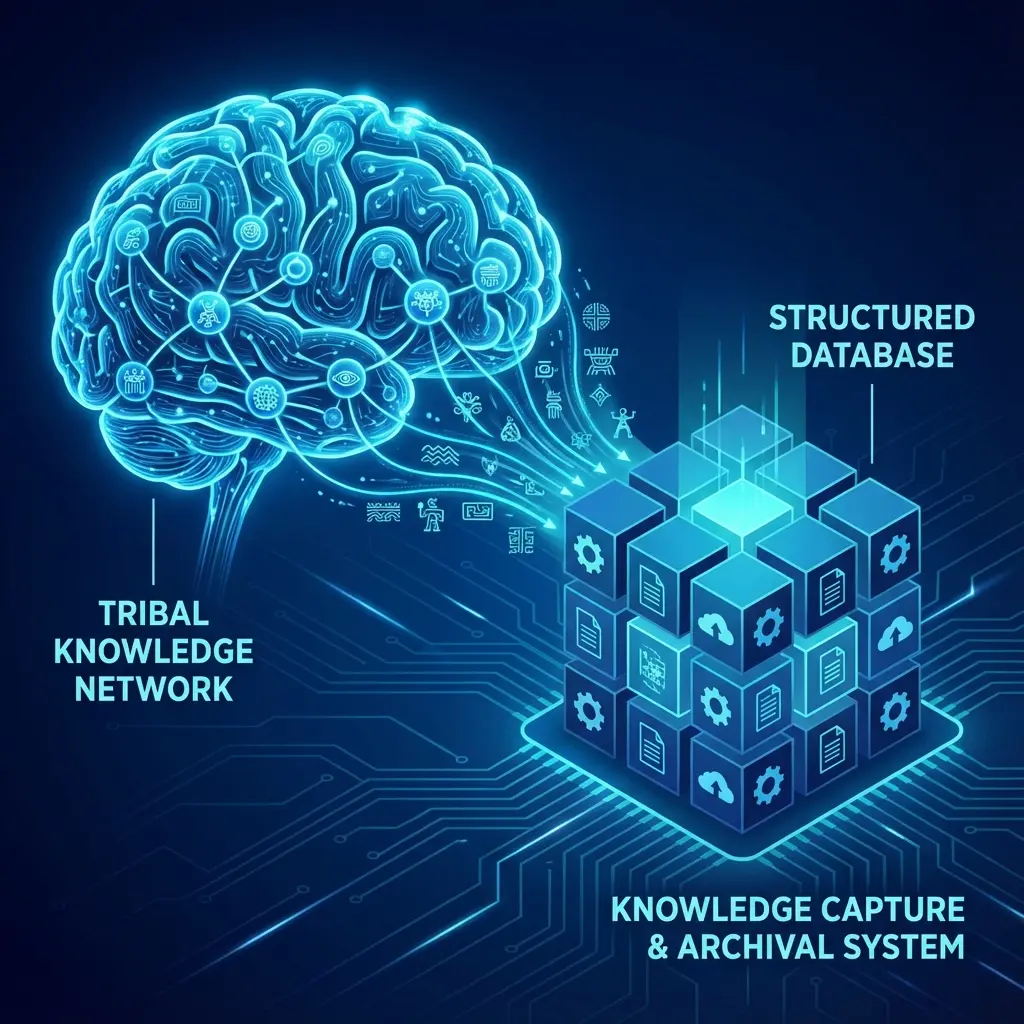
The Anatomy of Tribal Knowledge
Tribal knowledge is the unwritten information that is not commonly known by others within a company. It is the "secret sauce" of how things actually get done, as opposed to how the procedure manual says they should be done. In a small startup, this fluidity is an asset; it allows for speed and agility. However, in a Tier-1 bank or a scaling FinTech, it becomes a liability.
When a core banking process relies on a specific individual knowing "how we've always done it," you introduce a Single Point of Failure (SPOF). This is often referred to as "Key Person Risk" or the "Bus Factor"—if that person gets hit by a bus (or more likely, gets poached by a competitor), the process grinds to a halt.
The Real-World Consequences
The impact of this dependency is not theoretical. We have seen it manifest in catastrophic ways:
- Settlement Failures: In complex OTC derivatives or syndicated loan settlements, the "happy path" is often automated, but the exceptions require manual intervention. If the only person who understands the manual workaround for a specific counterparty is on leave, trades fail to settle. This leads to compensation claims, reputational damage, and potential fines under CSDR (Central Securities Depositories Regulation).
- Regulatory Breaches: Regulators like the ECB (European Central Bank), PRA (Prudential Regulation Authority), and FCA (Financial Conduct Authority) are increasingly focused on Operational Resilience (e.g., PRA SS1/21). They demand to see that important business services can withstand shocks. If a process breaks because one person is absent, you are not resilient. You are fragile.
- Inability to Scale: You cannot hire 50 new analysts and expect them to be productive if the training method is "sit next to Bob and watch what he does." Tribal knowledge is unscalable. It creates a bottleneck where the experts are too busy doing the work to train others, and the new hires are unable to work because they haven't been trained.
The Audit Trap: "If It Isn't Documented, It Didn't Happen"
30-second video summary
The golden rule of modern auditing is simple: If it isn't documented, it didn't happen.
Regulators and internal auditors are no longer satisfied with interviews where managers describe a robust control environment. They demand evidence. A verbal assurance of "we know how to do it" is a red flag. Auditors require concrete artifacts to prove that the control environment is designed effectively and operating effectively.
What Auditors Expect to See
- Standard Operating Procedures (SOPs): These are not high-level policy documents. These are detailed, step-by-step "click-level" instructions. They should be granular enough that a competent stranger could pick them up and execute the process with minimal errors.
- Process Maps (BPMN 2.0): Visual workflows are essential. They should show the end-to-end journey, including handoffs between teams, systems, and the specific decision points (gateways). We advocate for BPMN 2.0 (Business Process Model and Notation) because it is the industry standard that removes ambiguity.
- Control Points: The documentation must explicitly identify where the risks are and what controls mitigate them. For example, "Step 4: Verify the IBAN against the invoice." This is a control. It needs to be marked as such, and there needs to be evidence (a log, a tick box, a screenshot) that it was performed.
Moving from Tribal to Explicit Knowledge
Transitioning from an oral culture of tribal knowledge to a documented operational excellence framework requires a deliberate cultural shift. It is not just about writing things down; it is about changing how the organization values information.
Strategy 1: Process Mining
Before you start interviewing people, look at the data. Process Mining tools (like Celonis or UiPath) connect to your event logs (ERP, Core Banking, CRM) to visualize the actual process flows. You will often find that the "Happy Path" accounts for only 40% of cases, while the other 60% are a chaotic web of workarounds and exceptions. This data gives you the "ground truth" to challenge the tribal experts.
Strategy 2: Collaborative Mapping Workshops
Don't send a Business Analyst to sit in a corner and write a procedure. Run Brown Paper Sessions or digital workshops (using Miro or Mural). Get the Doers, the Managers, and the Risk/Compliance officers in one room.
- Ask the Doers: "What actually happens?"
- Ask the Managers: "What is supposed to happen?"
- Ask Risk: "What could go wrong?"
The friction between these three viewpoints is where the value lies. It allows you to agree on a standardized "To-Be" process that is realistic, compliant, and efficient.
Strategy 3: The "Wiki" Approach to Knowledge Management
Static Word documents stored on a shared drive are where knowledge goes to die. Modern documentation must be living, breathing, and accessible.
- Central Repository: Use tools like Confluence, Notion, or SharePoint to create a searchable knowledge base.
- Version Control: Every change to a procedure must be tracked. Who changed it? When? Why? Was it approved? This is critical for audit trails.
- Feedback Loops: Allow users to comment on procedures. If a step is unclear or outdated, the analyst doing the work should be able to flag it immediately.
Conclusion: Documentation is an Asset
Documentation is often viewed as "admin"—a chore to be done after the "real work" is finished. This mindset is dangerous. In a modern financial institution, the process is the product. The ability to execute a transaction correctly, legally, and efficiently every single time is what you are selling.
By capturing tribal knowledge and converting it into explicit, managed assets, you de-risk your business, satisfy your regulators, and unlock the ability to automate. You cannot automate what you do not understand. Documentation is the first step towards the digital future of banking.
Ready to do the structural work?
Our AI Enablement engagements are built around the five pillars in this article. We start with a focused diagnostic, then redesign one priority workflow end-to-end as proof — including the data layer, decision rights, and governance machinery.
Explore the AI Enablement serviceMore like this — once a month
Get the next long-form essay on AI enablement, embedded governance, and operating-model design straight to your inbox. One considered piece per month, written for senior practitioners in regulated industries.
No spam. Unsubscribe anytime. Read by senior practitioners across FS, healthcare, energy, and the public sector.
Related insights

Measuring Process Performance: The KPIs That Actually Drive Improvement
Most organisations track the wrong process metrics. This guide presents a proven KPI framework for process excellence—covering efficiency, effectiveness, compliance, and customer impact—with practical examples from financial services and regulated industries.
February 07, 2026
Continuous Improvement in Regulated Industries: Balancing Agility with Compliance
How regulated organisations can build a culture of continuous improvement without compromising compliance. A practical guide covering Lean in regulated environments, change control integration, and building improvement capability that satisfies auditors and delivers results.
January 31, 2026
BPMN 2.0 vs. Simple Flowcharts: Why Banks Need the Standard
Learn why financial institutions should adopt Business Process Model and Notation (BPMN) 2.0 over standard Visio diagrams for better automation and compliance.
November 25, 2025