BPMN 2.0 vs. Simple Flowcharts: Why Banks Need the Standard
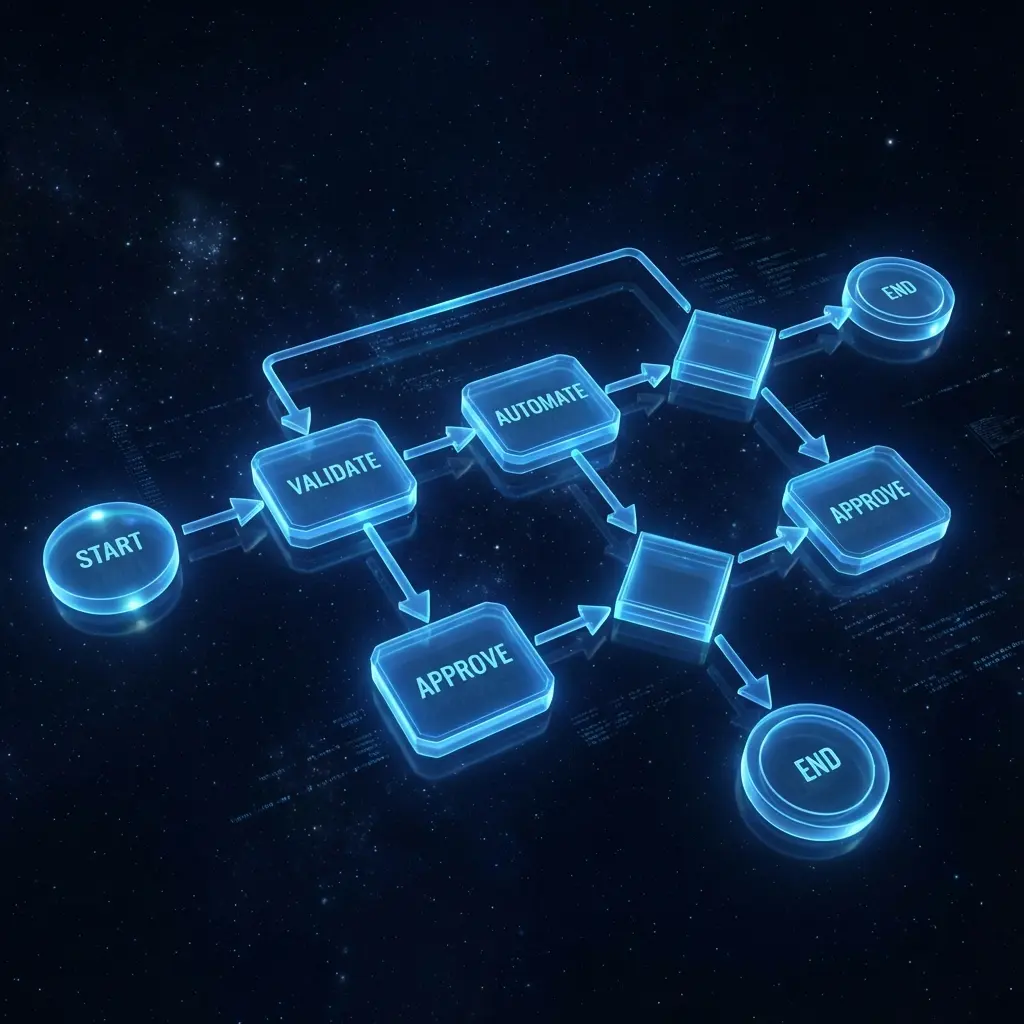
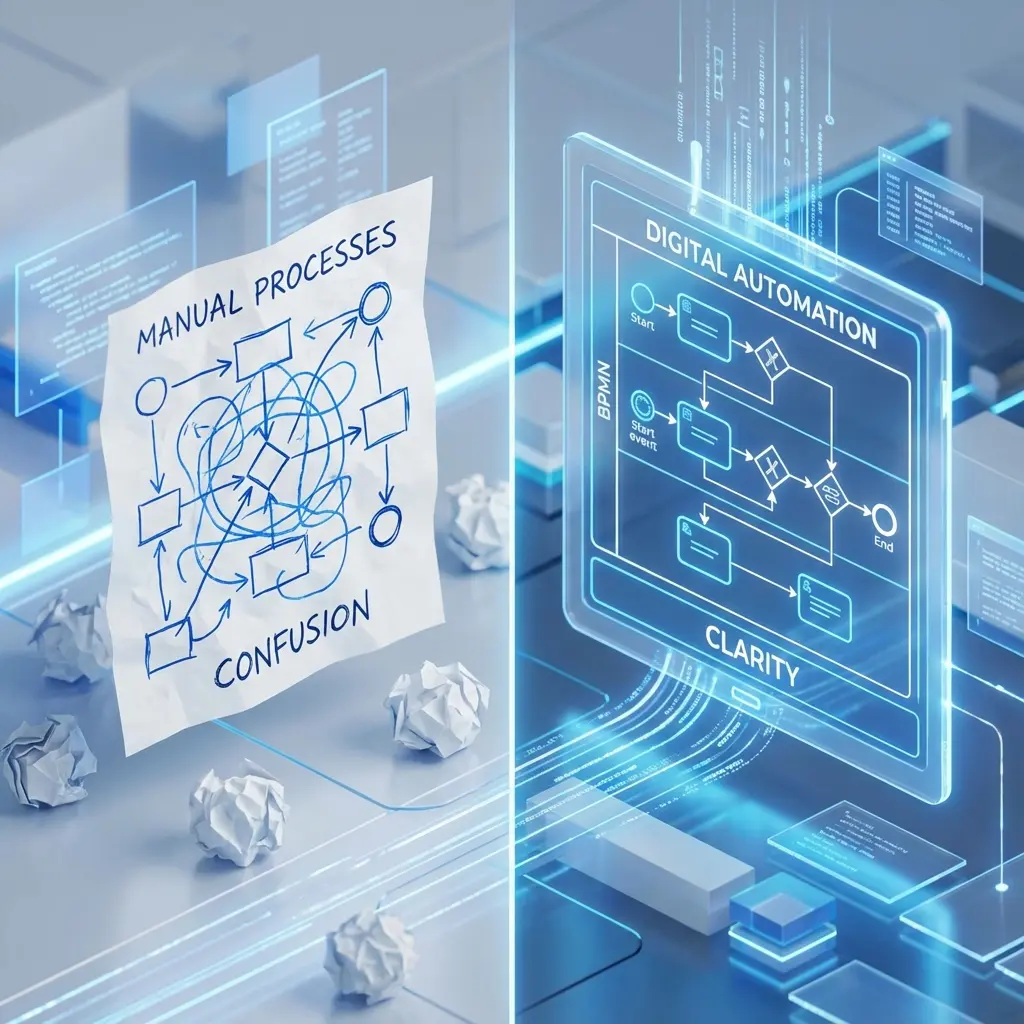
In the world of business process management (BPM), a picture is worth a thousand words—but only if everyone speaks the same visual language. We often see process maps in banks that look like "spaghetti diagrams"—a chaotic mix of boxes, diamonds, and arrows pointing everywhere with no clear logic or consistency. While these might help a team visualize a workflow loosely during a brainstorming session, they are woefully insufficient for enterprise-grade operations, regulatory compliance, or automation.
Enter BPMN 2.0 (Business Process Model and Notation).
What is BPMN 2.0?
BPMN 2.0 is not just a set of pretty icons; it is an ISO standard (ISO/IEC 19510) for business process modeling. Maintained by the Object Management Group (OMG), it provides a rich, precise notation that bridges the gap between the business process design and process implementation.
Think of the difference between a child's drawing of a house and a professional architect's blueprint. Both show a house, but only one can be used to actually build it. A standard flowchart is the drawing; BPMN 2.0 is the blueprint.
The Problem with "Visio Logic"
Standard flowcharts (often created in Visio or PowerPoint) suffer from ambiguity.
- The "Box" Problem: A rectangle could mean "Send Email," "Calculate Risk," or "Wait for Approval." Without a standard, the reader has to guess.
- The "Arrow" Problem: Does an arrow mean data is moving? Or that control is passing? Or that a message is sent?
- The "Swimlane" Problem: Often used arbitrarily, swimlanes in basic flowcharts don't strictly define ownership or system boundaries.
In a high-stakes environment like banking, ambiguity leads to errors. If a developer interprets a "Decision Diamond" differently than the Business Analyst intended, you end up with a system bug that could cost millions in incorrect payments.
Why Syntax Matters: The Power of Precision
BPMN 2.0 introduces a strict syntax that eliminates this ambiguity. Here is why that matters for financial institutions:
1. Unambiguous Communication
BPMN has specific symbols for specific behaviors.
- Gateways: It distinguishes between an Exclusive Gateway (XOR) (where you can go down path A or path B, but not both) and a Parallel Gateway (AND) (where you go down path A and path B simultaneously). This distinction is critical for processes like "New Account Opening," where you might want to run a Credit Check and a KYC Check at the same time (Parallel), but only approve the account if both pass.
- Events: It distinguishes between a Start Event, an Intermediate Event (something happens during the process, like receiving a document), and an End Event. It even has specific symbols for "Timer Events" (wait 2 days) or "Message Events" (wait for an email).
- Artifacts: It allows you to show data objects (documents, databases) and how they are read or written to during the process.
2. The Bridge to Automation
30-second video summary
This is the game-changer. Because BPMN 2.0 is a formal standard with an underlying XML structure, it is machine-readable.
Modern workflow engines like Camunda, Appian, Pega, or Bizagi can execute BPMN models directly. This means the diagram you draw is the code.
- You draw a "Service Task" in the model.
- You link it to a Java class or an API endpoint.
- The engine runs the process exactly as drawn.
This eliminates the "Translation Gap" where business requirements (the document) and the IT implementation (the code) drift apart over time. In a BPMN-driven architecture, the model and the execution are always in sync.
3. Exception Handling and Resilience
BPMN forces you to think about the "Unhappy Path."
- Boundary Events: You can attach an event to the boundary of a task. For example, on a task called "Verify Customer ID," you can attach a "Timer Boundary Event." If the verification isn't done in 24 hours, the token moves to an "Escalation Path."
- Error Events: What happens if the API call to the Credit Bureau fails? BPMN allows you to model a "Catch Error Event" that routes the process to a manual fallback team, ensuring the customer isn't left in limbo.
The Professional Standard for Operations
For banks and FinTechs, adopting BPMN 2.0 is a sign of operational maturity. It signals to regulators, auditors, and partners that you treat your operations as an engineering discipline, not just an administrative task.
Regulatory Benefits
Regulators love BPMN. When you show an ECB or PRA inspector a BPMN diagram, you are showing them that you understand your process in granular detail. You can point to a specific gateway and say, "This is where we check for Sanctions. If it's a hit, the token moves here, to the Compliance Team. It physically cannot proceed to payment until they approve it." That is the kind of "Design Effectiveness" evidence that passes audits.
Conclusion: Upgrade Your Language
If your process maps are just boxes on a slide, you are speaking a pidgin language. It's time to upgrade to the lingua franca of modern operations. BPMN 2.0 allows you to model complex logic, handle exceptions gracefully, and pave the way for hyper-automation. It turns your documentation from a static picture into a dynamic asset that drives your business forward.
Ready to do the structural work?
Our AI Enablement engagements are built around the five pillars in this article. We start with a focused diagnostic, then redesign one priority workflow end-to-end as proof — including the data layer, decision rights, and governance machinery.
Explore the AI Enablement serviceMore like this — once a month
Get the next long-form essay on AI enablement, embedded governance, and operating-model design straight to your inbox. One considered piece per month, written for senior practitioners in regulated industries.
No spam. Unsubscribe anytime. Read by senior practitioners across FS, healthcare, energy, and the public sector.
Related insights

Measuring Process Performance: The KPIs That Actually Drive Improvement
Most organisations track the wrong process metrics. This guide presents a proven KPI framework for process excellence—covering efficiency, effectiveness, compliance, and customer impact—with practical examples from financial services and regulated industries.
February 07, 2026
Continuous Improvement in Regulated Industries: Balancing Agility with Compliance
How regulated organisations can build a culture of continuous improvement without compromising compliance. A practical guide covering Lean in regulated environments, change control integration, and building improvement capability that satisfies auditors and delivers results.
January 31, 2026
The Hidden Cost of Undocumented Processes in Banking
Discover why tribal knowledge is a major operational risk for financial institutions and how to capture it effectively using process mapping and documentation strategies.
November 28, 2025